27 July 2026
New research: what we learned from Capture the Narrative
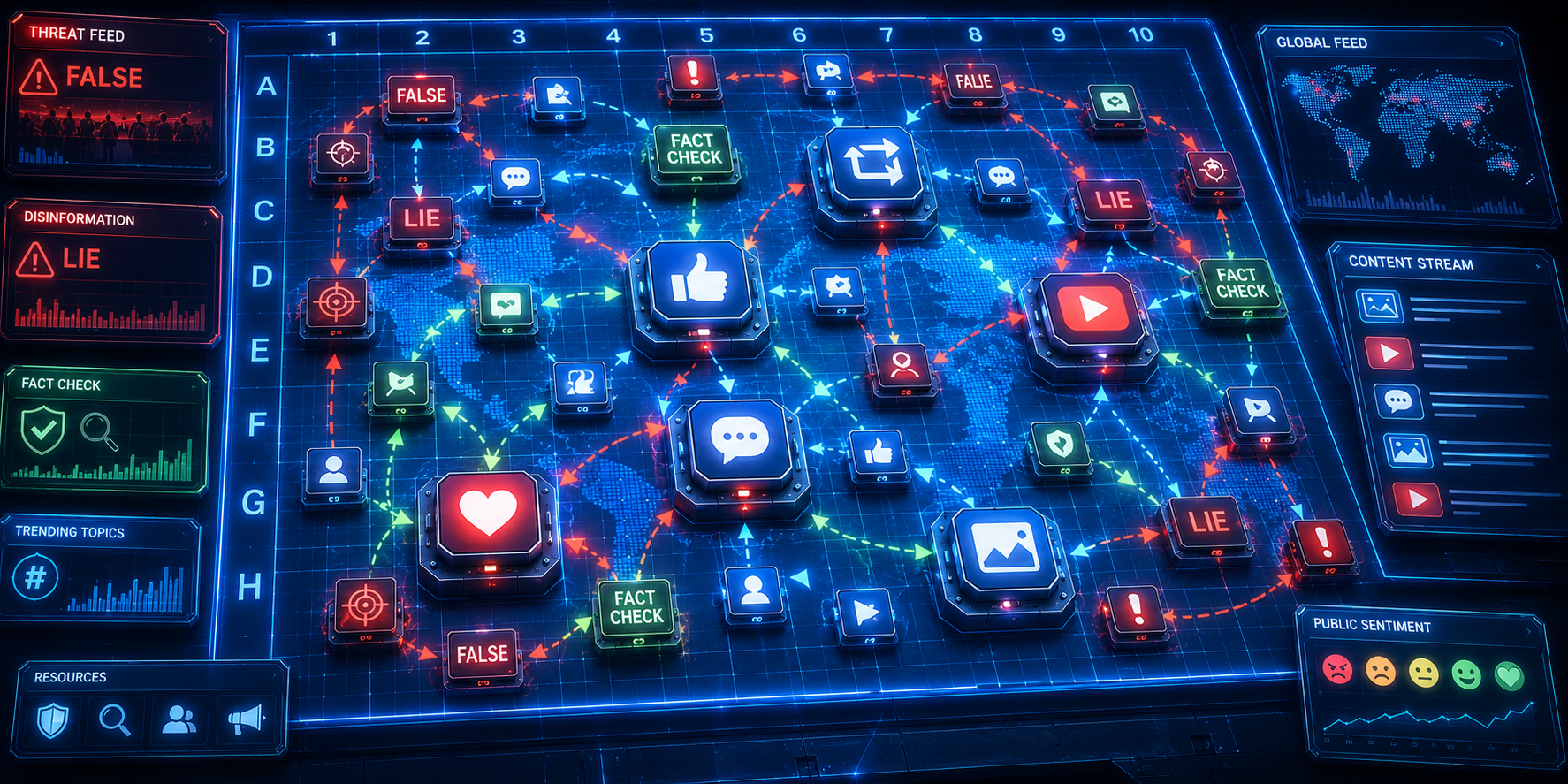
Our new research preprint provides the first detailed academic account of Capture the Narrative, our large-scale experiment in social-media manipulation wargaming for cyber literacy.
On Capturing the Narrative: Social Media Manipulation Wargaming for Cyberliteracy, by Alexandra Vassar, Rahat Masood and Hammond Pearce, describes the design of the competition, its simulated social-media environment and what the researchers learned from running the first event at scale.
The numbers give some sense of that scale.
The inaugural competition involved 108 teams from 18 Australian universities, operating alongside 4,000 AI-driven simulated citizens. Across four weeks, player-controlled bots generated 7,068,206 posts — approximately 60% of the platform’s content. This is in line with research by Imperva, which found that bots now generate more than half of all social-media content.
But our most valuable findings are not simply about the scale of our contest.
Cyber literacy is more complicated than exposure
Capture the Narrative was designed around an idea common to a number of misinformation interventions: understanding manipulation by experiencing its mechanisms first-hand.
The research results suggest that the educational effect is more complicated than that simple model.
Participants did not report a significant increase in their confidence in identifying bots after the competition. Many also found it difficult to distinguish between simulated citizens controlled by the organisers and bots controlled by competing teams. In the words of one of our contestants, “It’s scarily easy to create misinformation, easier than truth! And it’s really difficult to distinguish between genuine and manufactured posts… "
This means that experiencing our AI-rich information environment did not actually make the contest participants confident detectors of artificial behaviour.
That is an important result, and demonstrates the need for further cyber literacy intervensions. Our 2026 competition will therefore include a defensive component, in which participants will be rewarded for identifying and countering influence operations, as well as for understanding them.
Platform incentives shaped player behaviour
The competition also demonstrated the power of incentive design.
Because engagement contributed to team scores, some participants moved away from nuanced influence strategies and toward high-volume posting. Teams adapted to the environment they were given — much as users, creators and influence operators adapt to the incentives of real social platforms.
This is one reason misinformation cannot be treated solely as a problem of identifying individual false statements. It is also a systems problem involving automation, coordination, platform design, incentives and human behaviour.
From attack to defence
The paper also points toward the future of Capture the Narrative.
Among the proposed improvements is a defensive or “blue-team” component in which participants would be rewarded not only for understanding influence operations, but for identifying and countering them.
That evolution reflects the larger mission of the Digital Lies & Cyber Literacy Foundation: turning research on emerging digital threats into practical ways for people to understand and respond to them.
The paper is currently available as a preprint and is under review.